
TL;DR
Once DeepSeek runs inside Claude Code, its thinking depth can only be one of the official low, high and max, and the extra tokens between levels do not buy a matching return: across the 89 tasks of Terminal-Bench 2.1, max spends 2.2 times the output tokens of low per task and does not solve a single task more. We treat thinking depth as a measurable working point, search it guided by the model’s internal readout, and let CCT, a local relay, apply the result to every request. Compared with running at an official level, the working points we found are:
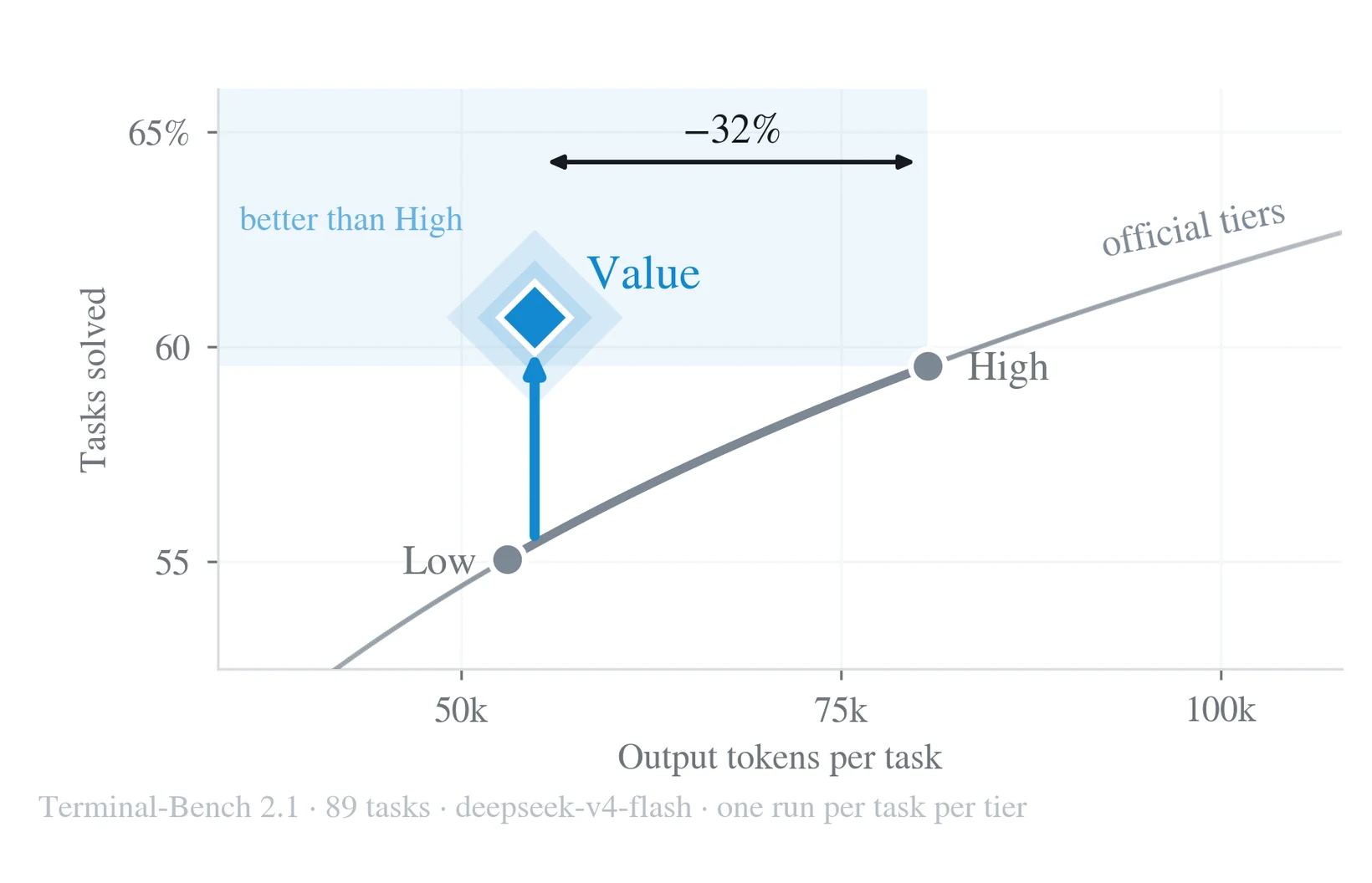
- Cheaper, and better. The Value tier solves 60.7% of the tasks at about 55k output tokens per task, a better result than official high on 32% fewer output tokens (Figure 1).
- Finer. Classic and Extra fall between low and high and between high and max, turning the three official levels into five.
- Deeper. Deeper outputs 7% more per turn than max, a depth the official levels do not reach.
None of this involves training: the weights, Claude Code’s prompt and its tools all stay as they are; every change is applied by a relay private to the session and recorded on the cost receipt at exit (Section 4).
1. Introduction
Running DeepSeek inside Claude Code is now common practice: DeepSeek offers an endpoint compatible with the Anthropic message format and an official integration guide1, and Claude Code only has to be pointed at it. Once connected, thinking depth is set by the official levels: DeepSeek’s thinking mode has only low, high and max2, Claude Code chooses among them with /effort, and the spacing between levels is set by the provider. Per task, high spends about 1.5 times the output tokens of low and max about 2.2 times.
More tokens do not always buy a better result. Across the 89 Terminal-Bench 2.1 tasks, max does not solve a single task more for its extra tokens. Nor is there anything between the levels: a task that needs more than low but less than high has to settle for one or the other.
The obvious fixes are to run at a higher level throughout, or to switch /effort by hand from task to task. The first only adds cost; the second still chooses among the same three levels, and someone has to judge every task.
Instead of choosing among preset levels, we measure against the model itself: we treat thinking depth as a measurable working point, generate candidates in bulk with a self-evolving search, screen them by a readout of the model’s internal reasoning state and score them on real benchmarks (Section 2); the ones selected ship as CCT tiers, chosen when Claude Code starts (Section 4).
1.1 Official levels and CCT
CCT keeps the three official levels; what differs is where its levels come from and where they can land (Table 1).
Table 1Official levels and CCT’s working points
| Official levels | CCT | |
|---|---|---|
| Levels | low, high, max | The three official levels, plus Value, Classic, Extra and Deeper |
| What changes | Thinking budget | Preamble and thinking settings |
| Selected by | Provider default | Internal readout and benchmark measurement |
| Beyond max | None | Deeper |
| Model and Claude Code | Unchanged | Unchanged: no fine-tuning, no byte of prompt or tool removed |
2. Method
The method has two parts (Figure 2): finding working points offline, and applying them to every request online.
2.1 Working points: preamble and thinking settings
A working point has two parts: a preamble, a short text spliced at the head of the system prompt, 168 to 565 bytes for the four tiers Value, Classic, Extra and Deeper; and the request’s thinking settings. The preamble replaces and compresses nothing in Claude Code. The relay injects the tier’s preamble at the head of the system prompt and normalises the request’s thinking.type to enabled, so that the client cannot flatten the depth; budget_tokens and the other fields are left as they are, and fields the client did not send are not added. What the user writes is never rewritten, compressed or retained under any tier; the preamble texts are not reproduced here.
2.2 Generating and screening candidates
The candidates are not written by hand. We observe the model’s reasoning at the level of neurons, generate candidate preambles (thinking anchors) in bulk with a self-evolving, high-throughput search, screen them with a readout of the model’s internals, and score each survivor on real benchmarks. The readout comes from two earlier works of our team: JAR (Jacobian Axis Readout) reads an interpretable reasoning state from inside the model and couples it to native MoE routing3; RAD (Routing Agreement Decoding) shows that MoE routing itself carries a signal usable for reasoning control4. As a result, the tiers that ship were selected by measurement, not by the taste of whoever wrote them.
2.3 Evaluation setup
Every working point is evaluated on the 89 tasks of Terminal-Bench 2.1 with deepseek-v4-flash, one run per task per level. The metrics are the share of tasks solved and the output tokens per task; the reference is official low, high and max in the same setup. The calibrated output per turn of each level ships with CCT (tiers.json), and CCT’s cost receipt is computed from it.
3. Results
This section tests the three results of the TL;DR in turn, and each could fail: a working point cheaper than the official levels might not exist; the effect of a preamble on depth might not be controllable enough to land between two levels; and max might already be the ceiling of the model’s thinking. Together the three tests give one picture: thinking depth can leave the three preset marks of the official ladder and be placed where it is needed, cheaper, finer or deeper.
3.1 Cheaper: Value
Value leaves the cost–return curve of the official levels: with about the tokens of low, it solves more tasks than high. Along the official levels, results rise with tokens, and spending fewer tokens usually means solving fewer tasks; if Value were one more point on that curve, it would lie on it. In Figure 1, Value uses about 55k output tokens per task, close to what official low uses, yet solves 60.7% of the tasks, more than official high; at the same token count it sits 5.3 percentage points above the curve through the official levels, and against high it uses 32% fewer tokens. Value is therefore not one more mark on the official ladder but a working point off it; it is also CCT’s default tier.
Value is nothing more than a preamble of 256 bytes. That raises the next test: whether the effect of a preamble on depth can be controlled, that is, whether different preambles put the model’s thinking where they are meant to.
3.2 Finer: Classic and Extra
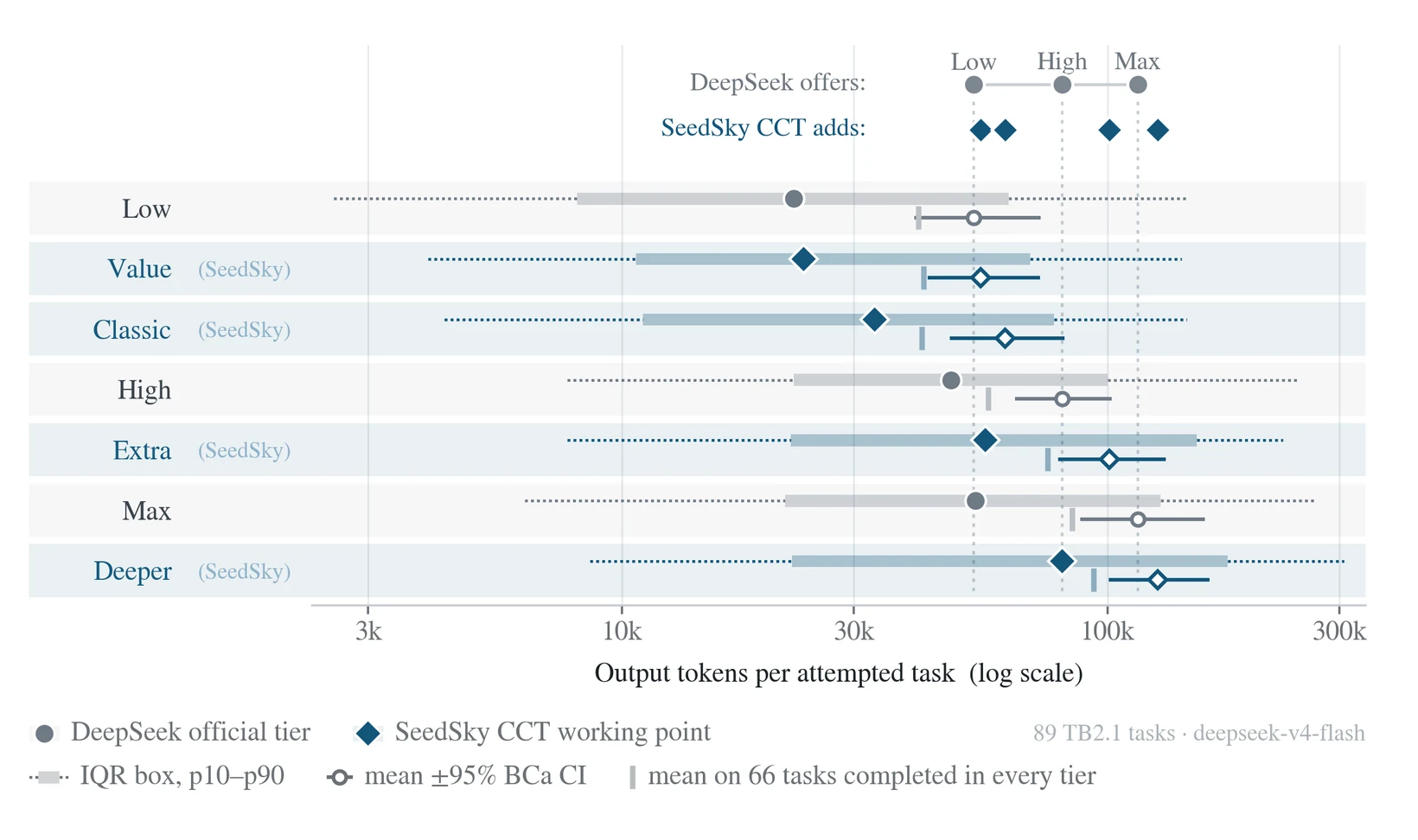
Two preambles put thinking depth between low and high and between high and max. If a preamble only worked by chance, different preambles would not line up in the designed order, and some might be pushed back onto an official level. Figure 3 sets the per-task output-token distributions of all seven levels side by side: by the mean, Classic lies between low and high and Extra between high and max. The calibration shipped with CCT gives the same order (Figure 4): low, Classic, high, Extra and max output 934, 1,170, 1,539, 1,832 and 2,226 tokens per turn.
tiers.json), from which CCT’s cost receipt is computed.The official ladder thus becomes five levels, with Classic and Extra standing for Claude Code’s medium and xhigh. What remains is the top of the ladder: whether max is already the ceiling of thinking depth.
3.3 Deeper: past max
Deeper pushes thinking depth past max: it outputs 7% more per turn. If max were the ceiling, any preamble would only bring the output back to around max. In Figure 3, both the median and the mean output per task of Deeper lie to the right of max; by the calibration, Deeper outputs 2,382 tokens per turn, 7% more than max (Figure 4). /effort could not reach this region before; Deeper is meant for tasks worth the extra tokens, such as long chains of reasoning and hard-to-locate bugs.
4. CCT: applying a working point to every request
For these results to hold in everyday use, a working point has to apply to every request, including the ones Claude Code sends in the background. CCT is a launcher for Claude Code, installed with npm install -g @seedsky/cct: put cct in front of the usual command, pick a tier at launch, and read a cost receipt at exit (Figure 5). It does not bundle Claude Code and never holds the user’s key; the authentication headers each request carries are forwarded unchanged. Table 2 lists what each tier does and its calibration.
Table 2CCT’s reasoning-effort tiers
| Tier | How to pick | What it does | Out / turn |
|---|---|---|---|
| Flex | Picker 1 | Hands depth back to Claude Code’s /effort: low, high and max pass straight to the official levels, medium and xhigh land on Classic and Extra | per /effort |
| Value (default) | Picker 2 | Beats official high with less output | 1,145 |
| Classic | -e classic | Between low and high | 1,170 |
| Extra | -e extra | Between high and max | 1,832 |
| Deeper | Picker 3 | Past max | 2,382 |
Out / turn is the calibrated output in tokens; official low, high and max are 934, 1,539 and 2,226.
4.1 A private relay per session
Private relay. Each session starts its own relay on an ephemeral port of 127.0.0.1 and terminates it by process id at exit, so sessions never interfere; ANTHROPIC_BASE_URL is injected into the wrapped Claude Code process only, never exported globally.
Pinned sessions. Value, Classic, Extra and Deeper govern every request of the session. Claude Code’s /effort no longer applies, but not silently: the launch banner states that /effort is locked, and the exit receipt counts how often it was overridden.
Flex sessions. Depth goes back to Claude Code’s own /effort: low, high and max pass straight to the official levels, and medium and xhigh land on Classic and Extra, which gives the five-level ladder.
settings.json pin. At launch Claude Code writes the env block of settings.json back into the process environment, which can override the address CCT injected and route traffic around the relay. CCT adds --settings to the session and pins the single key ANTHROPIC_BASE_URL; the user’s settings file is not modified on disk.
Ledger. Each session writes a JSONL ledger with bookkeeping fields only (model name, token counts, cache hits, latency, status code), never conversation content or keys.

  … your Claude Code session …

✓ Saved ≈48.6% cost · ≈12s faster
◆ Value ×14 · in 241,806 tok(cache hit 73.1%) · out 9,118 tok · paid ¥0.28(off-peak rate)
picker.py runs under a pseudo-terminal and receives real arrow keys, and the emulated screen is captured, so no frame is drawn by hand; without a key press the default is confirmed after three seconds, and on Windows and in terminals without animation the picker falls back to a numbered list. Bottom: the receipt of a Value session from the README. The picker’s Proven, Swift and Peak tiers come from a separate line of work that this article does not cover.4.2 The cost receipt
The receipt at exit has two lines (bottom of Figure 5). The first is the benchmark: the same work run end to end at official max is the baseline, the saving is computed from the calibrated output per turn, and time is counted at 10.2 ms per output token; a Deeper session claims no saving and states instead how much deeper than max it went. The second line is the breakdown and the amount paid: hits per tier, input and output tokens, the cache-hit rate, and an estimate priced request by request at DeepSeek’s time-of-day rates, with 9:00–12:00 and 14:00–18:00 Beijing time as peak and the remaining hours at half price. The amount on the receipt is an estimate from the ledger; DeepSeek’s own bill is authoritative.
5. Conclusion
Thinking depth need not be chosen among a provider’s three preset levels. Searching against the model’s internal readout finds a working point off the official ladder that costs less and does better, fills in the ladder between its rungs, and extends it past max.
The working points in this article change thinking depth only: the weights stay as they are, and no byte of Claude Code’s prompt or tools is removed. All of them ship as CCT tiers; the tier table and the arithmetic behind the receipt are in the GitHub repository.
Citation
@misc{seedsky_cct2026,
  title  = {CCT: Working Points Beyond the Official Ladder},
  author = {{SeedSky Team}},
  year   = {2026},
  url    = {https://seedsky.ai/papers/cct/},
  note   = {Code: https://github.com/seedsky-ai/cct}
}
References
- Integrate with Claude Code. DeepSeek API Docs.
- Thinking mode. DeepSeek API Docs.
- Beyond the Trace: Coupling an Interpretable Reasoning-State Readout to Native MoE Routing. arXiv:2608.17638, 2026.
- Does the Same Token Mean the Same State? MoE Routing as Signal for Reasoning Control. arXiv:2606.22798, 2026.